

Want to make your online store eco-friendly? Start here. Customers are prioritizing brands that care about the planet, with 74% of U.S. adults considering environmental impact before buying. Plus, sustainable businesses enjoy higher returns and faster growth. This guide breaks down seven actionable steps to align your store with these values while improving efficiency and cutting costs:
- Eco-Friendly Packaging: Use recycled materials and reduce excess packaging to lower emissions and save money.
- Green Web Hosting: Switch to renewable energy-powered hosting to cut your website’s carbon footprint.
- Smarter Shipping: Optimize delivery routes, consolidate shipments, and offer carbon-neutral shipping options.
- Transparent Supply Chain: Track and share your supply chain’s impact to identify inefficiencies and build trust.
- Carbon Tracking: Measure your emissions, target reductions, and involve customers in offsetting efforts.
- Return and Reuse Programs: Reduce waste by reselling, refurbishing, or recycling returned products.
- Sustainability-Focused Branding: Highlight your efforts to attract eco-conscious buyers and boost loyalty.
The bottom line: Consumers are ready to support businesses that care about the planet. Start small – whether it’s switching to green hosting or using better packaging – and build from there. These steps don’t just help the planet; they also improve your store’s performance.
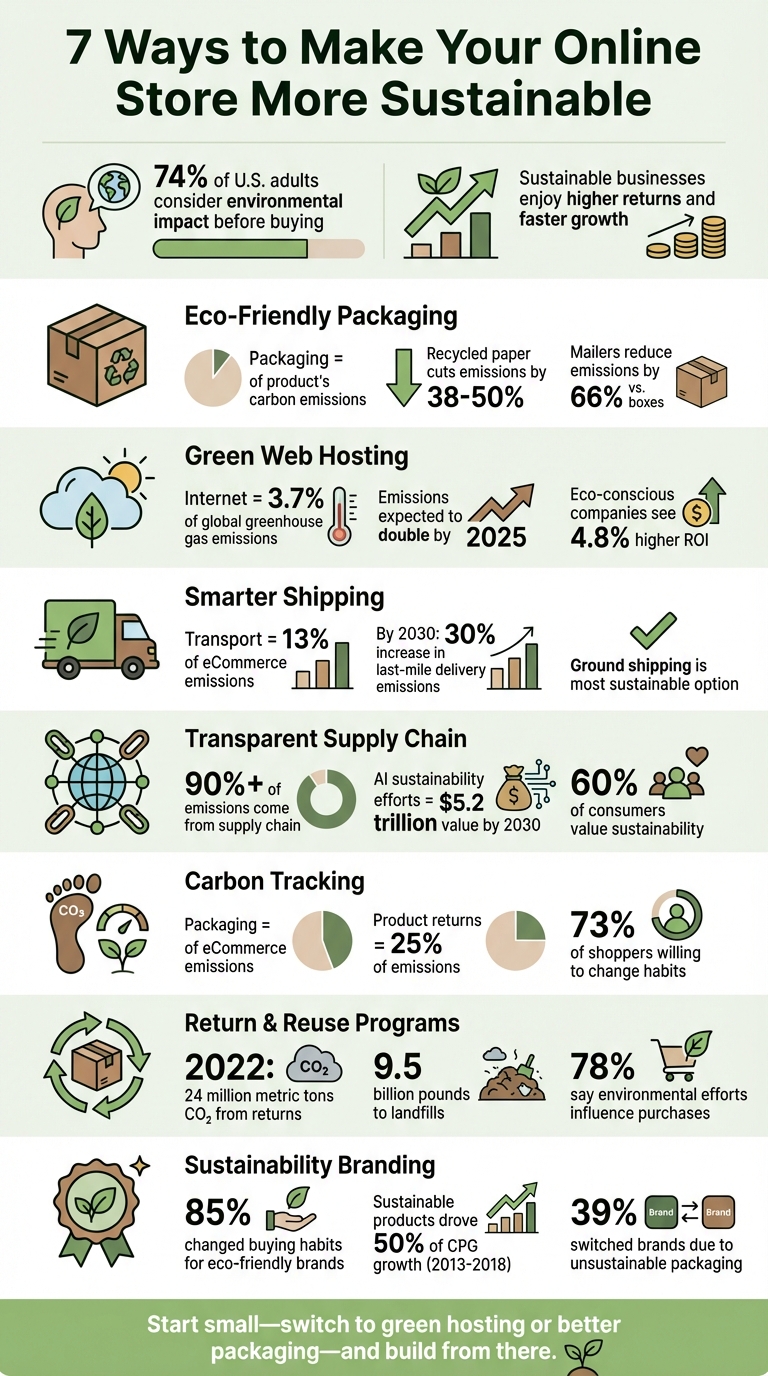
7 Ways to Make Your Online Store More Sustainable
1. Use Eco-Friendly Packaging
Reducing Carbon Footprint
Did you know that packaging contributes to 5% to 10% of a product’s total carbon emissions? That makes it one of the easiest areas to tackle for businesses aiming to reduce their environmental impact. For instance, using fully recycled paper can slash greenhouse gas emissions by 38–50%, while recycled poly mailers cut emissions by about 40%.
Consider this: producing one ton of 100% recycled corrugated boxes (about 4,000 boxes) saves 3.6 million metric tons of CO2 emissions. Even simple changes, like reducing excess air in packaging by 25%, can cut shipping emissions by the same percentage. And for items like clothing, swapping boxes for mailers can lower packaging-related emissions by 66%.
These environmental shifts don’t just help the planet – they can also improve efficiency and save money.
Boosting Operational Efficiency
Sustainable packaging isn’t just good for the environment; it’s also a smart business move. Mailers, for example, cost 50% less than boxes and weigh only a third as much. This translates to lower shipping costs and less need for warehouse storage. Custom-fit packaging, which eliminates the need for void fillers, also avoids penalties from dimensional weight (DIM) pricing.
Take Rothy’s, for example. The footwear brand created shoe boxes made from 85% post-consumer recycled materials, strong enough to ship without an outer box. This "box-in-a-box" approach eliminates extra packaging and doubles as a return container. Meanwhile, Lush takes it a step further by shipping about 35% of their products "naked" – completely without packaging – saving over half a million cellulose bags annually.
Meeting Consumer Expectations
Sustainable packaging isn’t just a trend – it’s becoming a consumer expectation. The sustainable packaging market, valued at $270 billion in 2024, is forecasted to grow to $490 billion by 2034. In the U.S., 55% of consumers express concern about packaging’s environmental impact, and 60% to 70% are willing to pay more for eco-friendly options. In fact, 57% of consumers are willing to pay at least 10% more for sustainable packaging and shipping.
Patagonia is a great example of a brand that understands this shift. As of March 2024, they use Forest Stewardship Council (FSC) certified recycled materials or post-consumer waste for all their bags, boxes, and paper mailers. Their philosophy resonates deeply with their audience:
"The best packaging is no packaging. That’s why we’re committed to reducing our impact and simplifying our shipping materials".
2. Switch to Green Web Hosting
Environmental Impact Reduction
Did you know your website has a carbon footprint? The internet is responsible for about 3.7% of global greenhouse gas emissions – equivalent to one billion tons of CO2 annually. Even more concerning, these emissions are expected to double by 2025.
Web hosting plays a big role here. Data centers that keep websites running 24/7 consume enormous amounts of electricity. Green web hosting tackles this issue by relying on renewable energy sources like wind or solar power or by purchasing carbon offsets to balance their emissions.
Take Etsy, for example. In March 2023, the platform committed to running entirely on renewable electricity and set a goal to achieve net-zero carbon emissions by 2030. Similarly, Kualo, a web hosting provider, partnered with Ecologi in November 2022 to implement a carbon-offsetting program. This initiative finances tree planting and renewable energy projects to counteract the emissions from its servers and clients’ ecommerce websites.
Switching to green hosting doesn’t just help the planet – it can also lower your operating costs.
Operational Efficiency Improvement
Green hosting isn’t just an environmental choice; it’s a financial one too. With energy prices on the rise, 73% of businesses are expected to face higher operational costs due to inflation. By adopting renewable energy sources, you can stabilize these expenses while improving your financial performance.
In fact, businesses that prioritize sustainability see measurable benefits. Studies show that eco-conscious companies achieve a 4.8% higher average return on equity and a 5.4% higher return on assets compared to less sustainable competitors. Plus, sustainable practices like resource management can boost revenue while cutting long-term costs.
Green hosting also supports website optimization. Features like image compression, lazy loading, and code minification reduce energy consumption while improving site speed and user experience. This dual benefit enhances your bottom line while aligning with eco-friendly goals.
And there’s more – embracing green hosting aligns your business with what today’s consumers care about most.
Customer Demand Alignment
Consumers are increasingly favoring businesses that prioritize sustainability. In fact, 85% of shoppers have adjusted their buying habits in the last five years to support eco-friendly brands. Among Gen Z and Millennials, over 90% consider sustainability – like the carbon footprint of digital services – a key factor in their decisions.
This shift can directly impact your sales. Globally, 68% of consumers are willing to pay more for sustainable products, and 74% actively consider the environmental impact of their purchases. By switching to green hosting and highlighting this commitment on your website and social media, you can build trust with eco-conscious customers and stand out in a competitive market.
As Constellation notes:
"Choosing the right data center, particularly one that optimizes energy use and looks for innovative power solutions, goes a long way toward business and e-commerce sustainability."
To make the switch, start by auditing your current hosting setup. Look for certified providers that use renewable energy or offer carbon-neutral programs. Once you’ve made the change, share your efforts through sustainability reports and social media. Adding certifications or eco-friendly seals to your website can further demonstrate your commitment and protect your brand from accusations of greenwashing.
3. Improve Your Shipping and Delivery Methods
Environmental Impact Reduction
Shipping and delivery play a big role in eCommerce emissions. Transport-level emissions alone make up 13% of all greenhouse gas emissions from eCommerce, and these figures are steadily climbing. By 2030, last-mile delivery is expected to increase carbon emissions by 30%, while parcel and freight shipping emissions could rise from 19 million tons to 25 million tons.
You can tackle this issue with smarter logistics. Combining orders into single shipments and organizing deliveries by geographic area helps reduce trips, fuel usage, and packaging waste. AI-powered route optimization can cut travel distances and idle time, directly lowering emissions. Another effective strategy is spreading inventory across regional fulfillment centers. This shortens last-mile delivery distances, allowing you to rely on ground shipping instead of carbon-heavy air freight.
Take Nuzest, for example. They introduced EcoCart to their online store in mid-2020, enabling 15% of their orders to ship carbon neutral. This move offset over 250,120 pounds of carbon emissions and boosted cart conversions by 22%. It’s a clear example of how improving shipping logistics can also streamline operations.
Operational Efficiency Improvement
Sustainable shipping doesn’t just benefit the planet – it can also save you money. Storing products in regional fulfillment centers reduces the number of shipping zones, cutting transportation costs and fuel consumption. For instance, Australian company Lucent Globe expanded to the U.S. and distributed inventory across multiple centers. This reduced transit times from over 10 days to just 2 days, while also lowering emissions and shipping costs.
Ground shipping offers another advantage: it produces fewer emissions than air freight and is more cost-effective. As EasyPost explains:
"Ground-based shipping is the most sustainable service level. While it is slower than expedited and overnight shipping, some customers are willing to wait if that means they’re helping the environment."
You can encourage customers to choose this option by making ground shipping the default and pricing air shipping higher. Offering a "specific delivery day" option encourages order consolidation, while flexible delivery choices like local lockers or scheduled time slots help avoid failed deliveries and unnecessary transport. These strategies not only reduce costs but also meet evolving customer expectations.
Customer Demand Alignment
Modern shoppers are increasingly aware of delivery-related environmental impacts. In fact, 28% of U.S. consumers consider the environmental effects of delivery when shopping online, and 57% are willing to pay up to 10% more for eco-friendly packaging and shipping. Furthermore, 87% of consumers say they view companies that support environmental causes more positively.
Shipping carriers are taking note. For example, in August 2021, DHL Express CEO John Pearson announced a seven-billion-Euro investment to cut greenhouse gas emissions. The plan includes electrifying 60% of DHL’s last-mile delivery fleet and acquiring 12 fully electric "Alice" aircraft from Eviation. Pearson underscored their commitment by stating:
"We firmly believe in a future with zero-emission logistics."
You can align with these shifting values by partnering with carriers that embrace electric vehicles, offering carbon-neutral shipping options at checkout, and clearly communicating your eco-friendly delivery practices. As Phantila Phataraprasit, founder of Sabai Design, puts it:
"I think customers understand if products take five to seven business days to arrive, especially if you explain the impact to them."
How to Make Your eCommerce Fulfillment Process More Sustainable – Michelle Harris, Our Serviceworks
4. Make Your Supply Chain Transparent
Beyond focusing on packaging and shipping, gaining a clear understanding of your supply chain is essential for achieving meaningful sustainability.
Reducing Environmental Impact
Did you know that over 90% of an organization’s greenhouse gas emissions and overall environmental impact come from its supply chain?. By mapping out your supply chain – from sourcing raw materials to final delivery – you can pinpoint areas with high levels of waste and emissions. This insight allows you to take targeted actions, like auditing suppliers to ensure they meet environmental standards for pesticide use, water treatment, and carbon emissions.
You can also reduce environmental harm by strategically placing inventory closer to your customers, which helps cut down on transportation-related emissions. Jess Page, co-founder of Open Water, shared:
"Since the day we started Open Water, every decision emphasizes sustainability, from 100% recyclable aluminum packaging to climate-neutral certification".
This level of transparency doesn’t just help the planet – it also lays the groundwork for smoother, more efficient operations.
Boosting Operational Efficiency
Transparent supply chains do more than reduce emissions – they also make your operations leaner and more effective. With real-time tracking, you can monitor products down to the serial number, enabling precise supplier evaluations. This approach helps you cut material costs, prevent overproduction, and minimize waste.
Emerging technologies like AI and machine learning are game changers here. They can optimize inventory levels, refine delivery routes, and even verify supplier credentials through blockchain. IoT devices add another layer of efficiency by providing real-time updates across your supply chain, helping you respond quickly to disruptions. By 2030, AI-driven sustainability efforts could contribute as much as $5.2 trillion in economic value.
Start by conducting a supply chain audit to evaluate the carbon efficiency of every partner, from raw material providers to last-mile delivery services. Then, establish clear sustainability guidelines for your vendors, covering energy use, carbon emissions, and waste management.
Meeting Customer Expectations
Today’s consumers expect transparency. In the U.S., 74% of shoppers care about the environmental impact of their purchases, and 60% of global consumers say sustainability is an important factor when deciding what to buy. Additionally, 68% are willing to pay more for environmentally friendly products.
Sharing detailed supply chain data builds trust and resonates with purpose-driven shoppers. Michael Klein, co-founder of Herbaly, highlighted this benefit:
"Our goal was simple: offset carbon emissions. In our search for the right partner, ShipBob was proactive. We can now share accurate data with our customers regarding the success of our reforestation initiatives".
sbb-itb-0d018d1
5. Track and Share Your Carbon Footprint
Reducing Environmental Impact
Tracking your carbon footprint goes hand in hand with supply chain transparency, giving you a clear picture of where your emissions come from. This insight helps you focus on the areas that matter most. For instance, packaging alone accounts for about 45% of an ecommerce company’s emissions, while product returns contribute roughly 25%. Beyond that, Scope 3 emissions – which include everything from manufacturing to delivery – can make up as much as 90% of your total emissions.
To get started, frameworks like the Greenhouse Gas Protocol are invaluable. They categorize emissions into three groups: Scope 1 (direct emissions), Scope 2 (purchased energy), and Scope 3 (value chain emissions). The Protocol suggests using a hybrid approach that blends actual consumption data with spend-based estimates to fill in any gaps. For small businesses, tools like the EPA‘s Greenhouse Gas Equivalencies Calculator offer an accessible way to begin tracking emissions. This kind of precise tracking not only sets the stage for operational improvements but also helps you communicate transparently with your customers.
Boosting Operational Efficiency
Carbon tracking doesn’t just highlight emissions – it also uncovers inefficiencies. As EcoCart puts it:
"Often, a company’s carbon footprint is the result of inefficient practices. As carbon accounting points out areas where you can reduce your GHG emissions, your solutions may also result in efficiency".
By pinpointing high-emission areas, like energy-draining warehouse operations or poorly planned delivery routes, you can make targeted changes that cut both emissions and costs. For example, JuneShine, a hard kombucha brand, used carbon tracking to involve customers in offsetting emissions. By October 2023, they had achieved a 43% adoption rate for carbon-neutral shipping and offset over 2.26 million pounds of carbon. Similarly, Simbly, a furniture company focused on sustainability, saw a 38% increase in average order size after introducing carbon-neutral shipping options.
Meeting Customer Expectations
Sharing your carbon data can build trust with eco-conscious consumers. Research shows that 73% of shoppers are willing to adjust their habits to reduce environmental impact, and 75% are likely to disengage from brands that lack sustainability efforts. Publishing real-time emissions data through dashboards or sustainability reports offers customers tangible proof of your commitment.
Take Wildway, a natural snack brand, as an example. They introduced a carbon-neutral shopping cart, allowing customers to play an active role in their sustainability mission. By October 2023, this initiative had offset 55.5 tons of carbon. Offering carbon-neutral shipping options at checkout – where customers can offset emissions for a small fee – not only appeals to environmentally conscious buyers but also turns them into partners in your efforts to reduce impact.
6. Create a Product Return and Reuse Program
Building on emission tracking, a well-thought-out returns program can significantly reduce waste and operating costs.
Reducing Environmental Impact
Product returns are a major contributor to waste in eCommerce. In 2022 alone, returns from online shopping produced about 24 million metric tons of CO₂ emissions, with 9.5 billion pounds of returned products ending up in landfills. On top of that, returns can increase delivery-related emissions by up to 30%.
An effective return and reuse program addresses this issue by reselling gently used products, refurbishing items for extended use, and recycling materials from unsellable goods. For items that are low-value or damaged, offering returnless refunds – where customers are allowed to keep or donate the product – avoids unnecessary shipping emissions and packaging waste.
Improving Operational Efficiency
Streamlined returns management doesn’t just help the planet – it also trims operational costs. Using disposition software to direct returns to the nearest recycling, donation, or resale facilities minimizes transportation distances and emissions. Additionally, offering Buy Online, Return In-Store (BORIS) options reduces the need for extra packaging and allows for quicker inspections and restocking.
"Our goal-setting process involves mapping out specific objectives, timelines, and resources needed… With this method, we are able to continually adjust our strategy so that we meet our short-term and long-term goals for increased sustainability."
- Grace Baena, Director of Brand at Kaiyo
Another impactful approach is establishing branded recommerce platforms, where businesses buy back and resell used items. This strategy extends product lifecycles and keeps items out of landfills.
Meeting Consumer Expectations
Shoppers are increasingly drawn to businesses with sustainable practices. In fact, 78% of consumers say a company’s environmental efforts influence their purchasing decisions. Providing eco-friendly return options not only satisfies this growing demand but also fosters stronger brand loyalty. Retailers can go a step further by offering incentives like loyalty points or discounts to customers who choose consolidated shipping or waive their return option.
7. Make Sustainability Part of Your Brand
Customer Demand Alignment
Sustainability is no longer just a buzzword – it’s a deciding factor for many shoppers. A whopping 73% of global consumers say they’re ready to change their buying habits to lessen their environmental impact, and 74% actively consider the environmental footprint of the products they purchase. Even more telling, 39% of consumers have switched brands purely because of unsustainable packaging.
Here’s the kicker: brands that focus on sustainability see a noticeable uptick in loyalty. Products marketed as sustainable drove 50% of the growth in consumer packaged goods between 2013 and 2018. Plus, sustainability claims can bump repeat purchase rates from under 30% to as high as 34%. By making environmental responsibility a visible part of your brand – not just a behind-the-scenes effort – you’ll attract customers who are eager to buy, recommend, and return.
This shift in consumer values isn’t just about preference – it’s a call for brands to visibly and meaningfully reduce their environmental footprint.
Environmental Impact Reduction
Meeting consumer expectations means your sustainability efforts need to be both transparent and impactful. Take Patagonia, for example. By pledging 1% of all sales to environmental groups and committing to carbon neutrality by 2025, the outdoor brand didn’t just minimize its footprint – it built a loyal following of eco-conscious customers. Similarly, Levi’s launched "Levi’s SecondHand" in 2020, a program that lets customers trade in used jeans and jackets for gift cards. These items are then resold in a dedicated marketplace, giving products a second life and reducing waste.
Packaging is another critical touchpoint. It’s where your brand’s commitment to sustainability becomes tangible. As Sarah Quirk from EcoEnclose aptly puts it:
"Your digital marketing may be the ‘talk,’ but your packaging is the ‘walk.’"
And it’s not just talk – eco-friendly packaging can turn buyers into advocates. Environmentally conscious customers are 58% more likely to leave reviews and recommend products with sustainable packaging.
Operational Efficiency Improvement
Making sustainability a core brand value doesn’t just resonate with customers – it can streamline your operations and improve your bottom line. Companies that prioritize eco-friendly practices see a 4.8% higher average return on equity compared to their less sustainable peers. A great example is retailer Simons, which opened an 80,000-square-foot zero net energy store in Quebec City in 2018. Powered by solar energy and a geothermal system, the store achieved a 60% improvement in energy efficiency compared to traditional setups.
Clear communication about your sustainability efforts also builds trust. In fact, 46% of customers say transparency about environmental practices removes barriers to purchase. Simple changes, like offering digital receipts, can make a big difference. Not only does it cut down on waste, but it also opens up new opportunities for marketing. As Alexis Damen from Shopify explains:
"Eliminating paper receipts not only helps reduce a business’s carbon footprint, it ensures that receipts aren’t later discarded as waste."
Conclusion
Creating a more sustainable online store doesn’t have to mean turning your entire operation upside down overnight. Take a cue from Allbirds, which managed to cut its average product carbon footprint by 19% in 2022 compared to the previous year. As they put it, "this is a game of inches and we’re big on near term, tangible progress". Their approach proves that small, steady steps can lead to meaningful change.
Start with a few manageable actions – like switching to recycled packaging or using green web hosting. These small shifts can add up quickly. Take Aldi UK, for example: by committing to using at least 35% recycled materials in its generic product packaging by January 2025, the company expects to reduce virgin plastic use by 78 tons annually. That’s a clear example of how focused efforts can make a difference – not just for the environment but also for your business.
There’s plenty of evidence that sustainability pays off. A striking 85% of consumers have changed their buying habits in the past five years to support companies with eco-friendly practices. The message is clear: your customers are ready for change, and they’re paying attention.
To make the most of this momentum, set achievable, step-by-step goals. Start by calculating your baseline carbon footprint and working with suppliers to identify greener options. As Jenny Longmuir from Taxually says, "Each small step contributes to a larger effort to protect our planet, ensuring that we can thrive in a healthy environment for generations to come".
Pick your starting point today. Whether it’s optimizing delivery routes or switching to digital receipts, each action builds on the sustainable strategies outlined here, helping your store – and the planet – move in the right direction.
FAQs
What are the financial benefits of switching to green web hosting for my online store?
Switching to green web hosting isn’t just about helping the planet – it can also make good financial sense. Many green hosting providers rely on energy-efficient systems and renewable energy, which often translates into competitive pricing. In some cases, these providers may even offer lower costs compared to traditional hosting services. On top of that, some green hosting companies sweeten the deal with discounts or perks for businesses that prioritize eco-friendly practices.
But the benefits don’t stop there. Choosing green web hosting can also give your brand a boost. Environmentally conscious customers are more likely to support businesses that share their values. This alignment can strengthen customer loyalty and even drive sales over time, making it a smart move for both your bottom line and your brand image.
How can I lower the environmental impact of product returns in my online store?
Reducing the impact of product returns on the planet starts with rethinking how the process works. One effective approach is consolidating return shipments. By grouping items from the same customer or area, you can cut down on trips and save on fuel. Another smart move? Opt for eco-friendly packaging – think recyclable or biodegradable materials that reduce both waste and shipping weight.
You can also give your customers greener return options. For instance, offer slower, carbon-neutral shipping or set up convenient drop-off points at local stores or hubs. Another way to tackle the issue is by preventing unnecessary returns altogether. Detailed product descriptions and accurate sizing guides can help customers make better choices upfront.
When items do come back, don’t let them go to waste. Assess whether they can be refurbished, resold, or even donated. This keeps products out of landfills and gives them a second life.
Lastly, keep track of the emissions tied to your returns. Setting measurable goals not only helps reduce your store’s carbon footprint but also shows customers you’re serious about making a difference. Small changes like these can go a long way in balancing sustainability with a great shopping experience.
How can I encourage my customers to support my store’s sustainability efforts?
Engage your customers by turning sustainability into a shared mission. Add straightforward, easy-to-spot labels like eco-friendly or low carbon footprint to your products, paired with a brief explanation (e.g., "This shirt saves 2 lbs of CO₂ per order"). At checkout, consider offering an opt-in option for carbon-offset contributions (e.g., "Add $1 to offset this shipment") and let customers choose eco-conscious packaging, such as recycled boxes or biodegradable mailers.
Encourage active participation by inviting customers to share recycling or upcycling ideas on a dedicated section of your site. Sweeten the deal with loyalty points or discounts for their contributions. Celebrate the collective impact of these efforts by sharing results in newsletters or order confirmations (e.g., "Together, we’ve saved 12,500 lbs of plastic this month"). By being transparent, offering sustainable options, and rewarding actions, you can make every purchase feel like a meaningful step toward a greener planet.
