

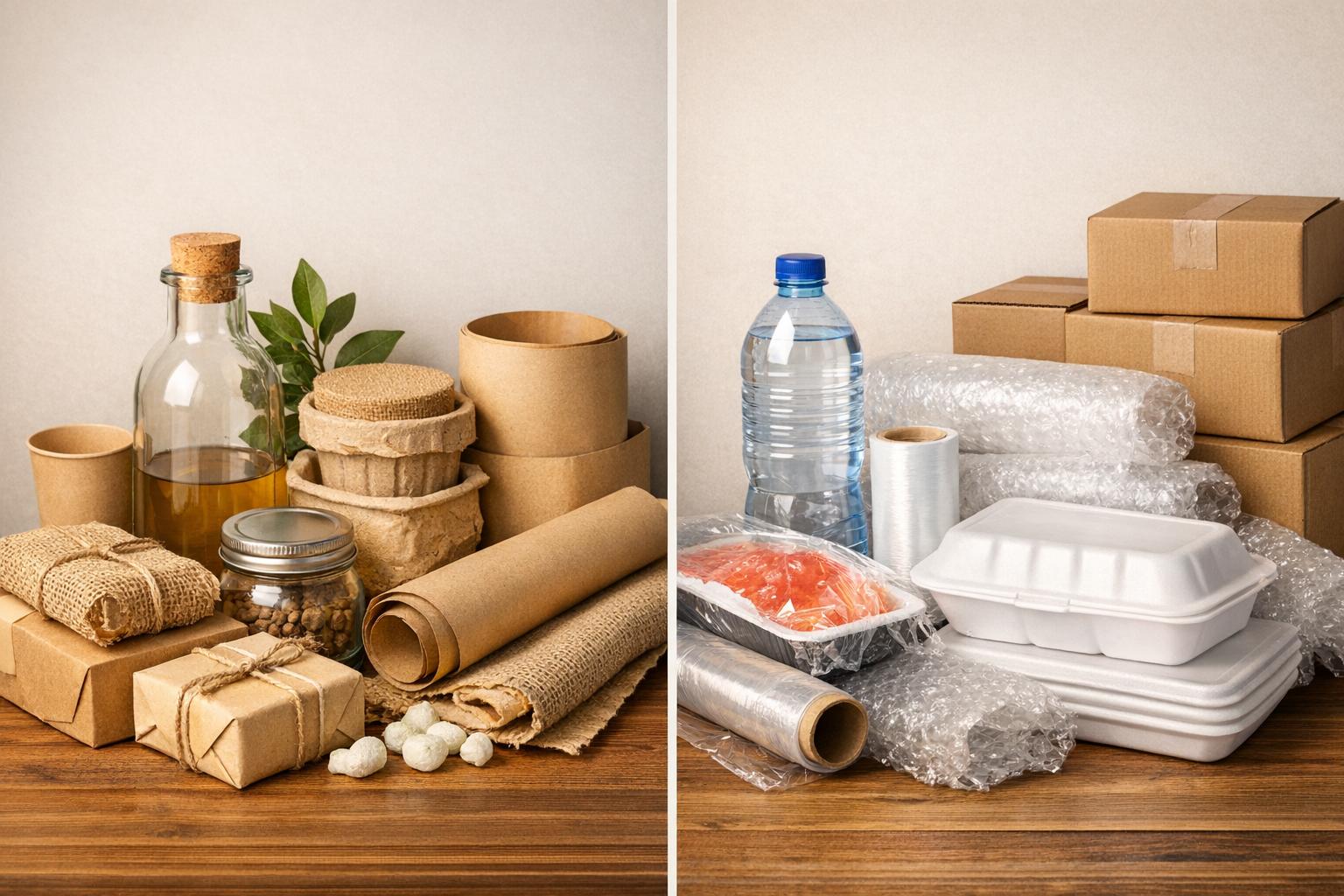
Switching to sustainable packaging can cost more upfront but offers long-term savings and aligns with growing consumer and regulatory demands. Here’s a quick breakdown:
- Sustainable Packaging: Higher initial costs (~$475,000 startup), but reduces waste, shipping expenses, and future regulatory risks. Consumers are willing to pay a premium, and it enhances brand loyalty.
- Traditional Packaging: Cheaper upfront, but waste, inefficiencies, and compliance risks can drive up long-term costs. Heavily reliant on non-renewable materials, which face increasing scrutiny.
Quick Comparison
| Factor | Sustainable Packaging | Traditional Packaging |
|---|---|---|
| Upfront Costs | Higher | Lower |
| Shipping Costs | Lower (optimizes space) | Higher (wasteful designs) |
| Regulatory Risk | Low | High |
| Consumer Perception | Positive | Declining |
| Durability | Improving | Reliable |
Key takeaway: While traditional packaging offers short-term savings, sustainable options provide better long-term value by cutting waste and meeting evolving market demands. Transitioning now can avoid future penalties and build stronger brand trust.
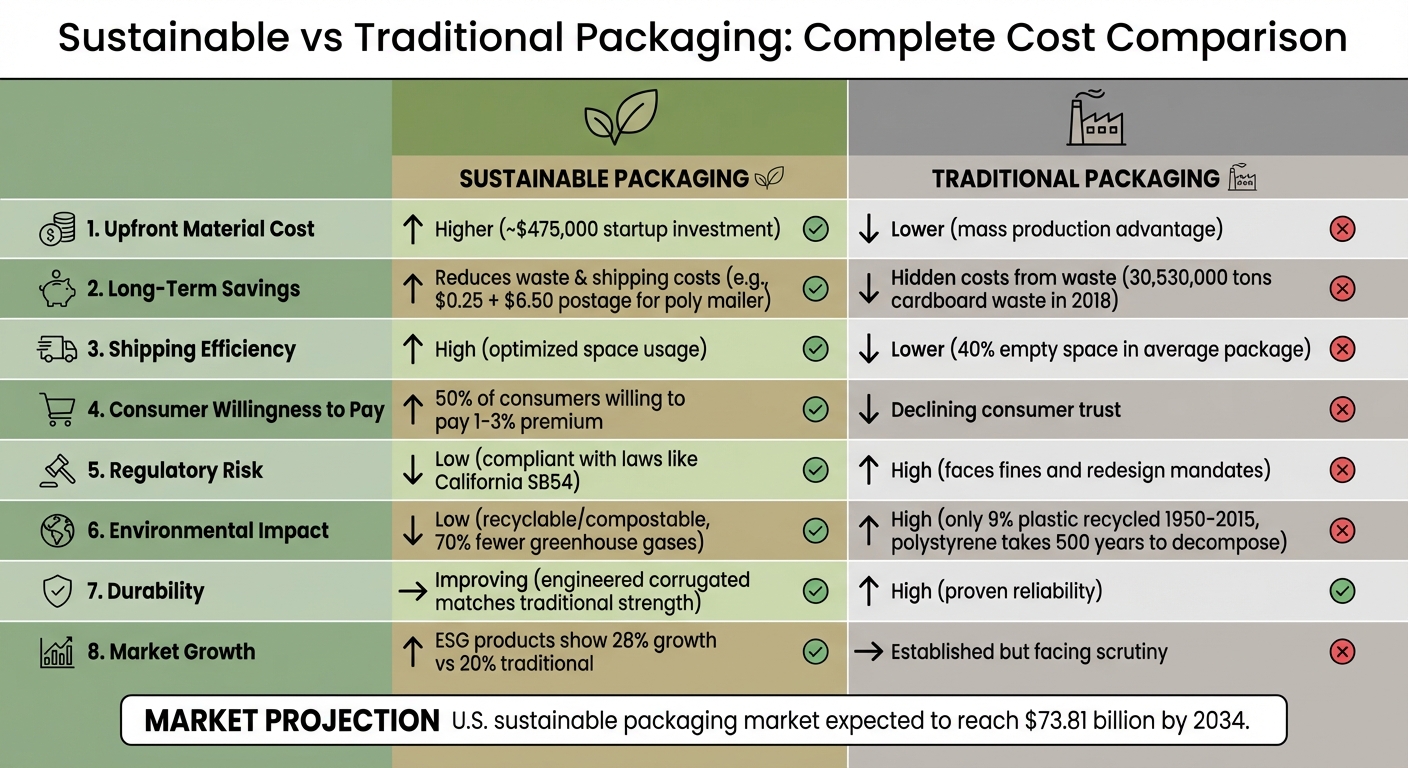
Sustainable vs Traditional Packaging: Cost and Performance Comparison
1. Sustainable Packaging
Initial Investment
Switching to sustainable packaging involves a significant upfront cost – around $475,000. This includes $250,000 for manufacturing equipment, $75,000 for initial inventory, and $45,000 to set up the office. On top of that, you’ll need a working capital buffer of about $1,253,000.
Eco-friendly materials come with a higher price tag compared to traditional plastics. However, there’s good news – about 50% of U.S. consumers are willing to pay a 1% to 3% premium for sustainable packaging, and 4% to 7% are even open to paying premiums above 10%. Operating a sustainable packaging business typically costs between $140,000 and $180,000 per month, with fixed R&D and compliance expenses averaging $2,500 monthly. While these upfront costs can seem daunting, the long-term financial benefits make the shift worthwhile.
Long-Term Savings
Investing in sustainable packaging isn’t just about doing the right thing – it makes financial sense in the long run. One of the biggest advantages comes from reducing waste. Traditional packaging often includes excess void space, which drives up shipping costs. Did you know that the average eCommerce package contains about 40% empty space? This inflates dimensional weight charges and fuel expenses. By switching to optimized corrugated boxes or minimalist designs, you can reduce fiber usage without compromising durability.
"This perspective redefines cost from an expense into an investment in efficiency."
- Darryl Waddell, York Container
Here’s a practical example: shipping a fleece jacket in a 100% recycled poly mailer costs roughly $0.25 per unit plus $6.50 in postage, compared to $0.85 and $11.25 for a corrugated box. Even switching to soy-based inks can save money. They’re often cheaper to produce than petroleum-based inks and provide more vibrant colors. On top of that, products that highlight Environmental, Social, and Governance (ESG) principles have seen 28% cumulative growth over five years, compared to 20% for products without such claims.
Regulatory Compliance Costs
Getting ahead of regulations by adopting sustainable materials early can save you from hefty fines and unexpected redesign costs. For example, California’s SB54 law mandates that packaging must be recyclable or compostable. Failing to comply could mean penalties and emergency adjustments to your packaging. Monthly compliance costs, including legal fees, insurance, and R&D, average around $4,200. Certifications like ISO 14000 or EN 13432 can validate your sustainability efforts and protect your brand from accusations of greenwashing.
"With states like California moving to require recyclable or compostable packaging, early adoption avoids costly redesigns and fines; ultimately turning compliance into a cost-saving advantage."
- York Container
Performance in Specific Applications
When it comes to performance, sustainable materials hold their own against traditional options in most eCommerce scenarios. Recycled LDPE (Low-Density Polyethylene), for instance, can match the performance of virgin plastic when properly optimized with the right gauge and multi-layer construction. Alternatives like corrugated bubble wrap and starch-based packing peanuts offer excellent cushioning for fragile items, which helps reduce costs tied to returns and replacements. Plus, bioplastics emit 70% fewer greenhouse gases in landfills compared to conventional plastics. Even cutting-edge options like mycelium packaging are gaining traction. While initially more expensive, they’re being adopted by major companies like IKEA due to their low-energy production process and complete biodegradability.
sbb-itb-0d018d1
2. Traditional Packaging
Initial Investment
Traditional packaging materials like non-recycled plastic and cardboard are known for their low upfront costs. These materials are cheap to produce and transport, making them appealing to companies aiming to cut initial expenses. However, the cost-effectiveness of traditional packaging often comes with a catch. Many businesses view waste as an unavoidable "cost of doing business" rather than something to eliminate. This mindset can lead to hidden expenses, as the short-term savings may be outweighed by inefficiencies over time.
Long-Term Savings
While traditional packaging might seem like a bargain at first, its affordability doesn’t always translate into long-term savings. Businesses frequently encounter rising costs tied to material waste and inefficiencies. For example, cardboard is used to ship over 90% of products in the U.S.. However, heavier grades of cardboard drive up shipping costs and contribute significantly to landfill waste – 30,530,000 tons were recorded in 2018 alone. Disposal costs from this waste are often treated as routine, adding to operational expenses.
Reusable options within traditional packaging, like plastic tubs or pallets, can offer better value over time by replacing single-use containers. Despite this, most businesses continue to rely on single-use solutions. While reusable packaging can save money, it often involves trade-offs in terms of product protection and exposure to growing regulatory risks.
Regulatory Compliance Costs
New legislation is adding financial pressure to businesses using traditional packaging. For instance, California’s SB54 mandates that all packaging must now be recyclable or compostable. Companies that fail to comply face fines and costly redesigns. Between 1950 and 2015, only 9% of the world’s plastic was recycled. With over 140 million tons of plastic packaging produced annually, regulatory scrutiny is becoming harder to ignore. Adopting compliant materials early can help businesses avoid penalties, but sticking with traditional packaging increasingly poses financial risks. Even so, traditional packaging remains strong in terms of functional performance.
Performance in Specific Applications
Traditional packaging shines in situations where durability and protection are top priorities. Take double-wall corrugated cardboard boxes, for example – they are the go-to choice for shipping heavy or fragile items because of their sturdy, multi-layered design. Similarly, traditional poly mailers are ideal for non-fragile goods like clothing, offering reliable protection against moisture. For temperature-sensitive products such as food or medicine, traditional "active packaging" solutions use features like oxygen absorbers, humidity controllers, and antimicrobial agents to ensure freshness and safety.
Moreover, the importance of protective packaging is reflected in consumer expectations. A striking 90% of customers say the condition of a delivered package is just as important as the product itself. This highlights how critical durable and functional packaging is to the overall customer experience.
Making Packaging Sustainable and More Cost Effective by Using Less Material
Pros and Cons
When it comes to packaging, the decision often boils down to balancing upfront expenses with long-term benefits, brand perception, and potential regulatory challenges. Traditional packaging stands out for its low initial costs and well-established infrastructure. Materials like non-recycled plastic and polystyrene are inexpensive to produce and ship. But this affordability comes with hidden drawbacks: potential fines from regulations like California’s SB54, growing consumer demand for sustainability – 81% of Millennials and 79% of Gen Z expect eco-friendly practices – and the cumulative costs of waste management.
On the other hand, sustainable packaging takes a different approach to costs. While the per-unit price may be higher, the long-term advantages often outweigh these initial expenses. These include reduced waste, better shipping efficiency, and stronger customer loyalty. In fact, about half of U.S. consumers are willing to pay a 1% to 3% premium for sustainable packaging.
"Sustainable packaging isn’t just about ‘being green’, but about applying lean manufacturing principles to eliminate waste and unlock measurable ROI." – Darryl Waddell, York Container
Durability is another consideration. Traditional materials, like double-wall corrugated cardboard and plastic poly mailers, excel in protecting heavy or fragile items. However, sustainable alternatives are catching up fast. For example, optimized corrugated designs can match the strength of traditional materials while using less fiber. That said, some biodegradable plastics may still pose risks, such as thinner designs that are less reliable during transit. Scalability also leans in favor of traditional packaging, thanks to its lighter weight and global supply chain infrastructure. Yet, sustainable options are gaining traction as the market for eco-friendly packaging is projected to reach $358.3 billion by 2028.
Summary Comparison
| Factor | Sustainable Packaging | Traditional Packaging |
|---|---|---|
| Upfront Material Cost | Higher unit costs | Lower due to mass production |
| Environmental Impact | Low; recyclable, compostable, or biodegradable | High; polystyrene takes 500 years to decompose |
| Shipping Efficiency | High when optimized for weight and size | Often lower due to oversized, wasteful designs |
| Consumer Perception | Builds loyalty | Can erode trust over time |
| Regulatory Risk | Low; aligns with new green laws | High; faces fines and redesign mandates |
| Durability | Improving; engineered corrugated matches traditional strength | High; plastic remains durable and reliable |
| Scalability | Growing; requires supply chain integration | High; backed by established global infrastructure |
While traditional packaging might seem like the economical choice upfront, its long-term costs – both financial and environmental – are becoming harder to ignore. This comparison highlights the need to rethink packaging strategies in light of evolving market demands and regulatory landscapes.
Conclusion
Choosing the right packaging goes beyond upfront costs – it influences the total cost of ownership. While sustainable packaging often comes with a 5–50% price premium, it can significantly lower long-term expenses. With 83% of U.S. brand managers predicting rising packaging costs by 2025, the real question isn’t if but when to invest in sustainability. The analysis here suggests the time for action is now.
To navigate these cost dynamics, businesses need a clear strategy. Think of packaging as an investment rather than just an expense. Start with practical, high-impact changes – like resizing boxes to cut dimensional weight charges or sourcing materials locally to save on shipping costs. Conduct a thorough packaging audit to spot inefficiencies, such as wasted materials or oversized designs, and make targeted improvements. Even small adjustments, like negotiating a 1% reduction in carrier rates, can lead to meaningful profit gains over time.
"The short answer might be that eco packaging doesn’t have to be expensive… over and over again we’ve found that the more sustainable solution can actually be cheaper."
- Robin Tan and Leo Chao, Co-founders, Zenpack
There’s a growing case for sustainability: ESG-compliant products consistently outperform others. Plus, with the U.S. sustainable packaging market expected to hit $73.81 billion by 2034, early movers can secure a competitive edge while avoiding the risks of inaction, like regulatory penalties or damage to brand reputation. The takeaway is clear: investing in sustainable packaging is not just about responsibility – it’s a smart business move.
To maximize benefits, consider strategies such as buying materials in bulk to reduce per-unit costs, using digital printing for smaller runs to avoid costly plate charges, and designing packaging with recyclability in mind from the start. Businesses that thrive in this space are the ones that see sustainable packaging as a pathway to greater efficiency, meeting consumer demands while boosting long-term profitability.
FAQs
What are the long-term cost advantages of using sustainable packaging?
Switching to eco-friendly packaging can bring long-term financial advantages that often offset its higher upfront costs. By cutting down on waste disposal expenses, using materials more efficiently, and reducing energy use during production, businesses can save a considerable amount over time.
Beyond cost savings, adopting sustainable packaging can boost a company’s image and attract environmentally aware customers. Many consumers today are not only drawn to brands that prioritize sustainability but are also willing to spend more on products with eco-friendly packaging. While the initial investment may seem steep, the combination of reduced operational costs and a stronger appeal to the market can make this shift a smart financial move over time.
How does using sustainable packaging help reduce regulatory risks for businesses?
Sustainable packaging isn’t just a trend – it’s becoming essential for staying in line with the growing number of U.S. regulations targeting waste reduction, recycling, and plastic usage. Across the country, federal and state policies are introducing taxes, fees, and outright bans on single-use plastics and materials that can’t be recycled. Some even mandate the use of recycled or compostable materials in packaging. By choosing eco-friendly options like biodegradable plastics or recycled cardboard, businesses can meet these requirements head-on, avoiding fines and extra costs.
Beyond meeting regulations, sustainable packaging makes it easier to align with initiatives like the U.S. EPA’s Sustainable Materials Management framework. This program emphasizes waste reduction and encourages businesses to report on material recovery efforts. By adopting sustainable practices, companies can cut down on the paperwork and reduce the risk of falling out of compliance. The benefits go beyond just avoiding penalties – embracing sustainable packaging helps businesses prepare for the future while contributing to environmental progress.
Why do consumers prefer sustainable packaging over traditional options?
Many people are leaning toward sustainable packaging these days, driven by a heightened awareness of environmental issues and a shared goal of cutting down on waste. Materials like biodegradable plastics and recycled cardboard are viewed as smarter, more responsible options that help lessen the impact of packaging on the planet.
On top of that, more shoppers are showing a willingness to back brands that make eco-friendly choices – even if it means spending a little extra. For businesses, adopting sustainable packaging isn’t just about being environmentally conscious; it’s also a way to connect with customers on shared values, fostering trust and loyalty along the way.
