

Eco-friendly shipping is no longer optional – it’s a priority for businesses and consumers alike. Here’s why it matters and how companies can take action:
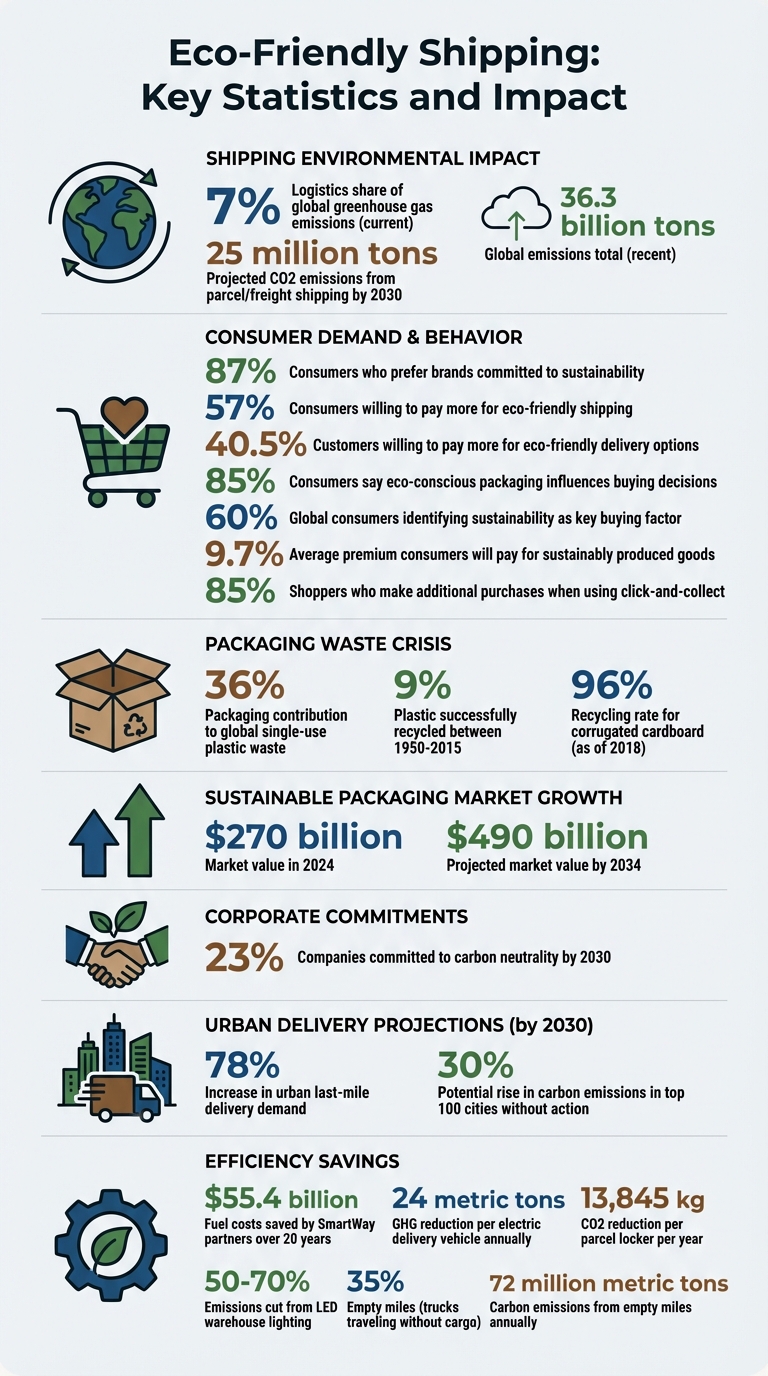
- Shipping Impact: Logistics account for 7% of global greenhouse gas emissions. By 2030, emissions from parcel and freight shipping could reach 25 million tons of CO2 annually.
- Consumer Demand: 87% of consumers prefer brands committed to sustainability, and 57% are willing to pay more for eco-friendly shipping options.
- Solutions: Businesses can reduce their carbon footprint through sustainable packaging, carbon-neutral shipping methods, route optimization, and partnerships with green carriers.
Key strategies include using recycled or compostable materials, offsetting emissions, and optimizing delivery routes. FedEx, UPS, and USPS offer greener shipping solutions, while third-party logistics (3PL) providers help reduce waste and emissions with smarter inventory management and eco-friendly fulfillment. Simple steps, like switching to paper tape or right-sizing packages, can make a big difference.
Eco-conscious shipping isn’t just better for the planet – it aligns with customer values and can reduce costs over time. Small changes today can lead to a cleaner, more efficient future for eCommerce.
Eco-Friendly Shipping Statistics and Impact 2024-2030
Less carbon, more care: How to ship green
Eco-Friendly Packaging Options for eCommerce
Did you know that packaging contributes to 36% of global single-use plastic waste? And yet, between 1950 and 2015, only 9% of all plastic was successfully recycled. With eCommerce booming, the demand for sustainable packaging has never been higher – 85% of consumers now say eco-conscious packaging influences their buying decisions. This shift is also reflected in the market, which was valued at $270 billion in 2024 and is expected to grow to $490 billion by 2034.
The good news? Choosing sustainable packaging doesn’t mean sacrificing product safety or profitability.
"It’s a net-positive impact on our bottom line, because customers do see it and they do value it",
says Eric Dale of TAMGA Designs.
The key lies in selecting the right materials and adopting smart strategies to reduce waste. Let’s dive into the best materials and practical ways to minimize packaging waste.
What Are the Best Materials for Eco-Friendly Packaging?
Switching to sustainable materials can reduce waste while meeting rising consumer expectations for environmentally responsible practices.
Recycled cardboard and paperboard are top choices for boxes and mailers. They’re widely recyclable and compostable, with corrugated cardboard achieving a 96% recycling rate as of 2018. For softer items like clothing, compostable mailers made from cornstarch, cellulose, and PBAT break down in commercial composting facilities within 90–180 days.
Looking for alternatives to Styrofoam? Mushroom packaging, made from mycelium, is biodegradable and works well as protective padding. For example, Dell uses mushroom-based inserts to ship electronics. Another innovative option is seaweed-based film, which is renewable, moisture-resistant, biodegradable, and even edible – perfect for replacing poly bags.
For lightweight, non-fragile items, recycled poly mailers made from 100% post-consumer waste offer a lower carbon footprint compared to paper options. However, these require specific recycling drop-offs for thin-film materials. Meanwhile, brands like Rothy’s are rethinking packaging entirely, creating shoeboxes from recycled paperboard that double as shipping containers.
| Material Type | Best Use Case | Environmental Benefit |
|---|---|---|
| Recycled Cardboard | Fragile items, heavy goods | Fully recyclable and compostable |
| Mushroom Mycelium | Protective padding, electronics | Biodegradable alternative to Styrofoam |
| Seaweed Film | Polybag replacement, food items | Renewable and home-compostable |
| Cornstarch/PBAT Mailers | Apparel, soft goods | Breaks down in compost facilities |
| Recycled Poly Mailers | Lightweight non-fragile items | 100% recycled content, reduces shipping weight |
Even small details matter. Switching to soy-based or algae-based inks can cut down on volatile organic compounds (VOCs) while delivering vibrant colors. Replacing plastic tape with water-activated paper tape simplifies box recycling.
How Can Businesses Reduce Packaging Waste?
Choosing sustainable materials is just the start. Optimizing how packaging is used can further cut waste and even reduce costs.
One of the simplest strategies is right-sizing. By tailoring packaging to fit products snugly and consolidating multiple items into one box, businesses can reduce void fill and shipping dimensions. For example, Holy Lamb Organics vacuum-seals mattresses, significantly cutting down on box sizes for shipping.
Instead of traditional bubble wrap, consider honeycomb paper or corrugated bubble wrap made from recycled materials. These provide excellent cushioning without plastic. For inner protection, glassine paper – an FSC-certified, recyclable alternative to poly bags – offers a plastic-free option. Zero Waste Cartel, for instance, reduces waste by selling bamboo toothbrushes in bulk, cutting down on per-unit packaging.
Using shipping software can also help optimize box sizes and combine multiple items into a single package. However, reducing waste doesn’t mean compromising on protection.
"You have to test everything on your own. You cannot rely on third-party certifications",
advises Anaita Sarkar, cofounder of Hero Packaging.
Conducting drop tests ensures that eco-friendly materials can handle the rigors of shipping without requiring extra layers of protection.
Finally, clear labeling helps customers dispose of packaging responsibly. Mark materials with instructions like "Recyclable", "Compostable", or "Reuse Me" to encourage proper handling.
Carbon-Neutral Shipping Methods
After tackling the issue of sustainable packaging, let’s shift our focus to another major contributor to eCommerce emissions: shipping. While eco-friendly packaging helps reduce material waste, the transportation of goods is a significant source of emissions. To put things into perspective, global emissions recently reached a staggering 36.3 billion tons. In response, 23% of companies have committed to achieving carbon neutrality by 2030, leveraging accessible tools to meet their goals.
So, what exactly is carbon-neutral shipping? It’s a process that offsets the emissions generated during transportation by removing an equivalent amount of CO₂ from the atmosphere. This involves both reducing emissions wherever possible and offsetting the remainder. To make meaningful progress, it’s essential to identify where these emissions originate – whether from your delivery fleet (Scope 1), the electricity powering your facilities (Scope 2), or third-party carriers like UPS and FedEx (Scope 3). Tools such as the EPA SmartWay program or carbon calculators can help you measure emissions and identify areas that need attention.
Interestingly, sustainability resonates with consumers: 40.5% of customers are willing to pay more for eco-friendly delivery options. Now, let’s explore how carbon offsetting transforms shipping emissions into actionable environmental gains.
What Is Carbon Offsetting and How Does It Apply to Shipping?
Carbon offsetting involves purchasing credits to fund environmental projects – such as reforestation, renewable energy initiatives, or methane reduction – that neutralize the greenhouse gases produced by shipping. For instance, Herbaly partnered with a fulfillment provider to offset emissions, sharing detailed reforestation data with customers. Co-Founder Michael Klein shared:
"Our goal was simple: offset carbon emissions. In our search for the right partner, ShipBob was proactive. We can now share accurate data with our customers regarding the success of our reforestation initiatives."
To ensure your offset programs are legitimate, choose those verified by organizations like the Climate Action Reserve or the American Carbon Registry. A key concept to consider is additionality – the idea that the carbon reduction wouldn’t have occurred without your funding.
That said, offsetting should complement, not replace, efforts to directly reduce emissions. As Fannar Jonsson, Quality and Environment Manager at Blue Lagoon Skincare, notes:
"Minimize upfront investment and maximize positive impact on the planet by utilizing the simplest way to incorporate sustainability into your brand’s operations, carbon offsetting."
Start by calculating your baseline emissions using tools like EPA SmartWay. From there, work on reducing emissions through strategies such as distributing inventory across multiple fulfillment centers to shorten transit distances, optimizing packaging to fit more items per shipment, and switching to energy-efficient LED lighting in warehouses, which can cut emissions by 50% to 70%. Once you’ve reduced emissions as much as possible, offset the remainder through verified programs. Tools like Ecocart and Route even allow customers to offset emissions at checkout.
How Does Route Optimization Reduce Emissions?

While carbon offsetting addresses the emissions you can’t eliminate, route optimization tackles emissions at their source by minimizing fuel use and travel distances.
Route optimization uses technology to ensure goods travel via the shortest and most efficient routes, directly reducing fuel consumption and CO₂ emissions. By cutting down on driving miles and idling, businesses can significantly lower their environmental impact. Advanced routing software also consolidates shipments, maximizing vehicle capacity and reducing the number of trips needed.
Take Food Huggers as an example. By leveraging distributed fulfillment centers, they reduced transit distances and pollution. Juliana Brasil, Director of Operations, explained:
"By shortening the transit distance, we get to shorten transit time and reduce the amount of pollution produced in the shipping process. Even in the final stages of fulfillment and last-mile delivery, ShipBob enables us to stay true to our mission!"
Another effective approach is modal shifting – moving shipments from high-emission modes like air freight or long-haul trucks to more efficient options like rail or electric vehicles. Carriers are also adopting electric delivery trucks and e-bikes for urban deliveries, which can reduce greenhouse gas emissions by 24 metric tons per vehicle annually. Even small changes, like using parcel lockers, can make a big difference; a single locker can cut CO₂ emissions by as much as 13,845 kg per year by reducing delivery attempts and travel distances.
Finally, partnering with EPA SmartWay–certified carriers ensures your shipping operations benefit from proven efficiency improvements.
Green Logistics and Carrier Partnerships
Choosing a carrier these days goes beyond just price and speed. The logistics partners you select have a direct impact on your environmental footprint, particularly through Scope 3 emissions, which are tied to third-party carriers. These partnerships play a pivotal role in reducing shipping-related emissions, and many major carriers are stepping up with sustainability initiatives and tools to help businesses measure and minimize their impact.
Which Carriers Offer Eco-Friendly Shipping Options?
In the U.S., FedEx, UPS, and USPS lead the charge in offering greener shipping solutions, each with distinct goals and strategies.
FedEx has set its sights on carbon-neutral operations by 2040. By 2025, they aim for half of their new parcel pickup and delivery vehicles to be electric, with a full transition by 2030. Additionally, they plan for 30% of their jet fuel to come from sustainable aviation fuel (SAF) by 2030. In 2024, FedEx committed to using over 3 million gallons of blended SAF at Los Angeles International Airport. The company has also invested $100 million into the Yale Center for Natural Carbon Capture. As FedEx CEO Raj Subramaniam puts it:
"Reducing emissions and helping to build a better, brighter world is critical for the future of our business, customers, communities, and planet."
UPS aims for carbon neutrality by 2050, with a mid-term goal of cutting carbon intensity per global small package by 50% by 2035. They offer a carbon-neutral shipping option, allowing businesses to offset emissions from individual shipments. According to UPS:
"UPS’s carbon neutral shipping option supports projects that help offset emissions associated with our customers’ shipments. These projects include reforestation, landfill gas destruction, wastewater treatment, and methane destruction."
USPS is focusing on operational efficiency, aiming to cut Scope 1 and 2 emissions by 40% and Scope 3 emissions by 20% by 2030. Their "Delivering for America" plan includes deploying over 66,000 electric vehicles by 2028 and shifting freight from air to ground transport where possible.
| Carrier | Carbon Neutral Goal | Key Eco-Friendly Service/Tool | Primary Strategy |
|---|---|---|---|
| FedEx | 2040 | FedEx Sustainability Insights | Vehicle electrification & SAF |
| UPS | 2050 | UPS Carbon Neutral (Offsetting) | Alternative fuels & renewable energy |
| USPS | N/A (2030 targets) | USPS BlueEarth Carbon Accounting | Surface transport & electric fleet |
These carriers also provide digital tools to track and report emissions. For instance, FedEx Sustainability Insights and USPS BlueEarth Carbon Accounting allow businesses to monitor Scope 3 emissions at both package and account levels. FedEx even offers an API pilot program that integrates with checkout processes, giving customers visibility into the environmental impact of their shipping choices.
For small-to-medium businesses, UPS’s carbon-neutral shipping option is an easy way to offset emissions without overhauling operations.
What Role Do 3PL Providers Play in Green Shipping?
While carriers handle transportation, third-party logistics (3PL) providers enhance environmental efficiency by optimizing product storage and shipping.
A key advantage of 3PLs is distributed inventory management. By storing products in regional fulfillment centers, they shorten shipping distances, which helps cut transportation-related emissions.
3PLs also address the issue of empty miles, where freight trucks travel without cargo roughly 35% of the time, adding 72 million metric tons of carbon-equivalent emissions annually. Using automated dispatch systems, 3PLs align deliveries with existing routes, reducing unnecessary trips.
Additionally, many 3PLs invest in energy-efficient warehouses. These facilities often feature LED lighting, advanced HVAC systems, and renewable energy sources like solar or wind. Automated systems like AutoStore and Locus Robotics increase efficiency and reduce energy consumption. Some facilities even pursue LEED certification, demonstrating their commitment to conservation efforts.
3PLs also promote sustainable packaging and order consolidation. They provide eco-friendly materials such as compostable mailers, biodegradable packing peanuts, and recycled kraft paper. Their systems minimize split shipments by ensuring orders are fulfilled from a single location, reducing both packaging waste and delivery trips.
Many 3PLs partner with carbon offset platforms like EcoCart, enabling businesses to neutralize the impact of last-mile delivery. For example, Blue Lagoon Skincare achieved a carbon-neutral ecommerce supply chain in 2025 by partnering with ShipBob, which offset emissions from fulfillment to delivery.
When choosing a 3PL partner, look for those participating in the EPA SmartWay Transport Partnership or those that actively track and report their carbon emissions. Ask about their use of recycled materials, certifications, and sustainable practices. A strong 3PL partnership can turn shipping operations into an eco-conscious advantage, especially when over two-thirds of purpose-driven shoppers are willing to pay a premium of 35% or more for sustainable products.
sbb-itb-0d018d1
Alternative Delivery Options
Traditional home delivery isn’t the only option – and it’s far from the most environmentally friendly. Alternatives like in-store pickup, local couriers, and consolidated drop-off points can significantly reduce emissions while still meeting customer needs. With urban last-mile delivery demand projected to increase by 78% by 2030, and a potential 30% rise in carbon emissions in the top 100 global cities without action, these alternatives are becoming essential. They also align with the broader sustainability strategies we’ve discussed.
Is In-Store Pickup a Greener Option?
In-store pickup eliminates the most carbon-heavy part of shipping: the last mile. Instead of sending a courier to each home, customers pick up their orders at a store, cutting out individual delivery trips altogether. This approach also helps keep inventory closer to customers, reducing the number of shipping zones a package needs to cross.
It’s not just about emissions, though. In-store pickup also reduces packaging waste. Orders fulfilled from store inventory usually don’t require the heavy-duty mailers or boxes needed for doorstep delivery. Retailers can use minimal packaging – or skip it entirely by handing items to customers in reusable bags. Plus, there’s a financial upside: 85% of shoppers make additional purchases when using click-and-collect services, turning pickup into a revenue generator.
By transforming retail locations into mini distribution hubs – often referred to as ship-from-store – businesses can keep inventory local, speed up delivery times, and lower shipping costs. For companies with physical storefronts, this strategy turns existing infrastructure into a sustainability win. To encourage more customers to choose pickup, consider offering discounts or highlighting the carbon savings compared to home delivery.
Should Businesses Use Local Delivery Services?
Local delivery services are another strong option for reducing environmental impact. Couriers using e-cargo bikes, electric scooters, or electric vehicles produce zero tailpipe emissions, unlike traditional diesel-powered vans.
Consolidated drop-offs with automated smart lockers further cut emissions by reducing individual trips and eliminating failed deliveries. Grouping orders from the same area into "green delivery slots" allows couriers to make multiple stops on a single, efficient route.
Partnering with local couriers doesn’t just help the planet – it can also strengthen community connections and enhance a brand’s appeal to eco-conscious shoppers. It’s a smart way to stay ahead of urban emissions regulations and "clean air zone" requirements. To make these services as efficient as possible, businesses can use AI-powered route optimization tools to plan the shortest delivery paths. At checkout, showing customers the environmental benefits of different delivery options can encourage greener choices.
How Ecommerce Green Supports Eco-Friendly Shipping
Ecommerce Green provides tailored solutions to reduce shipping emissions while improving efficiency and customer satisfaction. Their strategy combines sustainable packaging, smarter logistics, and expert consulting to help online businesses adopt greener shipping practices. These solutions work hand-in-hand with earlier efforts in sustainable packaging and logistics, creating a cohesive approach to eco-friendly shipping.
What Services Does Ecommerce Green Offer for Green Shipping?
Ecommerce Green offers a range of services to support environmentally conscious shipping:
- Eco-friendly packaging: Options include compostable mailers, recycled kraft paper for cushioning, and reusable envelopes with double adhesive strips to simplify returns.
- Logistics optimization: They help businesses distribute inventory across multiple fulfillment centers, strategically positioning products closer to customers. This reduces transit distances and cuts fuel consumption.
- Carbon offset programs: Through tools like EcoCart, businesses can purchase carbon credits on a per-order basis, offsetting the environmental impact of their shipping operations.
How Does Ecommerce Green Help Businesses Meet Their Goals?
In addition to offering sustainable materials and logistics solutions, Ecommerce Green assists businesses with strategic sustainability consulting to meet their environmental and operational goals.
Their consulting services include thorough assessments of current eCommerce practices, followed by actionable recommendations and ongoing progress tracking. They also provide access to an emissions calculator accredited by the Smart Freight Centre under the GLEC Framework and ISO 14083 standards, ensuring accurate greenhouse gas accounting.
Ecommerce Green goes a step further with package testing and design services to ensure sustainable packaging performs well while minimizing waste from damaged products. With 60% of global consumers identifying sustainability as a key factor in their buying decisions – and many willing to pay an average of 9.7% more for sustainably produced goods – these services help businesses align with customer values while driving revenue growth.
Conclusion
Eco-friendly shipping isn’t just about changing one aspect of your logistics; it’s about reimagining the entire process. A well-rounded strategy blends sustainable packaging – like compostable mailers and recycled kraft paper – with carbon offset programs that invest in environmental projects to balance out emissions. Pairing these efforts with smarter logistics, such as distributed inventory systems, partnerships with carriers using electric vehicles, and route optimization, creates a system that reduces both environmental impact and operational expenses.
The financial upside of these strategies is hard to ignore. For example, SmartWay partners have saved an impressive $55.4 billion in fuel costs over 20 years simply by improving efficiency. This shows that sustainability and profitability can go hand in hand.
Simple steps, like right-sizing packages to cut down on dimensional weight, prioritizing ground shipping, and adopting SIOC (Ships In Own Container) packaging, can immediately reduce waste and save money. From there, businesses can explore more advanced solutions, such as multi-location fulfillment centers and offering carbon offset options at checkout.
Each small improvement – whether it’s a lighter package or a shorter delivery route – contributes to environmental progress while fostering customer loyalty. The shipping challenge isn’t just a hurdle; it’s a chance for businesses to lead the way in sustainability.
FAQs
How can small businesses make eco-friendly shipping more affordable?
Small businesses can take practical steps to make eco-friendly shipping more affordable. One simple move is switching to recyclable or biodegradable packaging materials, which can often be cheaper when bought in bulk. This not only reduces waste but also helps cut costs. Another option is teaming up with logistics providers that offer carbon-neutral shipping or focus on environmentally friendly practices, allowing businesses to lower their carbon footprint without breaking the bank.
Streamlining inventory management and fine-tuning shipping routes can further reduce transportation costs and emissions. For those aiming to offset their carbon output, carbon offset programs provide an affordable way to achieve neutrality. By blending these strategies, small businesses can build a shipping process that’s both eco-conscious and cost-efficient.
What are some simple ways to reduce packaging waste in shipping?
Reducing packaging waste doesn’t have to be complicated. A few thoughtful adjustments can go a long way. Begin by opting for eco-friendly materials such as recyclable, compostable, or biodegradable options. Another simple step is to avoid overpacking – choose boxes that fit your products properly and cut down on excess fillers.
For a more forward-thinking approach, consider reusable packaging or materials derived from renewable resources, like plant-based plastics. These small shifts not only help cut down on waste but also align with your efforts to create a more environmentally conscious business.
What is carbon offsetting, and how does it work for shipping?
Carbon offsetting in shipping serves as a method to balance the carbon emissions generated during transportation. Companies achieve this by investing in projects that actively reduce or remove greenhouse gases from the atmosphere. These projects might include reforestation efforts, renewable energy advancements, or carbon capture technologies.
Through these contributions, businesses can work to offset their shipping-related emissions, aligning their logistics practices with environmental responsibility. It’s a meaningful way to reduce their carbon footprint while keeping shipping operations running smoothly.
